Don't miss my website!

Don't miss my website! Video lessons and more for teaching writers.
Showing posts with label common core. Show all posts

Monday, October 21, 2013

Reading Like a Writer


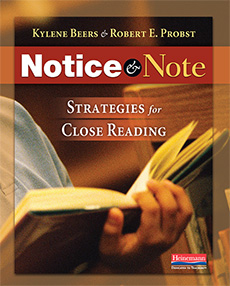
These are three books I'm hoping to dig into a little more. If you click on the titles, it will take you to Heinemann's website and sample chapters from all of the books.

Since Deb and I have been asked to encourage and support middle schoolers in annotating text and showing their thinking while reading content area material, I've changed my reading patterns a little. I'm especially looking forward to reading Chris Lehman and Kate Roberts book, Falling in Love with Close Reading that just came out a few days ago. I love being a constant learner and continually learning and growing. This is a very good journey to walk.

As a writer, it is important to know what kinds of books already exist when you thinking about a new writing project. Although not necessarily focused on close reading, Deb and I are tinkering with ideas that float around this topic and most definitely are thinking about annotating text. Also, by reading widely about a topic I am able to determine if it is something I want to spend time writing about or if my energy will wane and there is a better place to spend my writing time.

At the same time, I am reading widely about faith, happiness, and healing. Sometimes it is easy to feel like I have nothing to add to the book shelves. Then I remember one more story, one more perspective, one more angle is always a very good way to make the world a better place. 

This week, I'm reading like a writer. I'm determined not to let the Writing Monsters convince me that I shouldn't be writing.

Thursday, August 8, 2013

What kids need on the first day of school...

As a welcome gift when I was hired, my principal gave me the book The First Days of School by Harry K. Wong. It is an exceptional read. In fact, I just bought a new copy to give to a friend of mine who was hired as a middle school science teacher at a school in Kentucky. He does not have an education degree, nor does he have any classroom experience (or prior to June any desire to be a teacher).

One of the parts of the book that has stayed with me is a spread about what kids really need to know on the first day of school. The layout included text and cartoons of students with thought bubbles revealing their real needs on the first day of school. 

As teachers, we might think the most pressing needs on the first day of school are to cover the rules and expectations and to highlight the learning journey of the year.

According to Harry K. Wong, kids want to know where the bathroom is, if they will have friends, and whether the teacher will know their names. (This is what I remember from the book, however, it could be a little different since it's been years since I've opened to this particular page.) It's not important whether I get this verbatim, what is important is I remember kids have different first day of school needs than teachers.

I'm seeing this firsthand since I live with a second, third, fourth, and sixth grader. In addition, I'm spending this week with two high school seniors. We're talking (in tiny bits) about the new school year. All of them are less-than-thrilled about the first day of school (from the 7 year old to the 17 year old) because it's "boring" and "all you do is listen to things you can't do" and "teachers must think we're going to be awful."

"Maybe this year will be different," I say.

They give me that look.

Although less-than-thrilled about the first day, for the most part, they are looking forward to returning to school. They just aren't looking forward to the first day.

I think it's because the things that are most pressing to them may not be answered on the first day of school.

"What do you hope your teachers do on the first day?" I ask.

I think their answers are useful when considering first day plans.


I'm thinking through creative ways to meet their needs and to give an excellent first impression of what it means to be literate inside the walls of the classroom, as well as in the world -- both now and in the future. I'm thinking the rules and the syllabus can wait. Curiosity, communication, and community can't.

Monday, February 6, 2012

story = narrative + informational + opinion

Yesterday I had the privilege to hear James Kofi Annan tell his story. He is a survivor of child slavery. After he escaped, he eventually became a business man. Then he left his promising career in order to fight for freedom for Ghana's children. He started Challenging Heights as a place to protect and educate children.

I am moved by his story. It is one made up of nightmares and eventually overcoming them. It is a story of walking away from prestige and money. James' story faces the horrors of this world, and compels me to do everything I can, in my corner of the world, to make it right.

Which makes me think about writing and teaching writers, since that's what makes up much of my little corner of the world. This weekend I spent most of my reading time studying and highlighting and thinking about Common Core State Standards, as well as the PARCC Model Content Framework for ELA. It's not the easiest thing for me to read. I have to drink lots of water and eat Saletine crackers to try to keep my stomach settled. (It doesn't really work.) One of the things that is unsettling to me is the emphasis of nonfiction and opinion reading and writing at the sacrifice of narrative.

Story changes the world.

It is easy to get caught up in the push to prepare students for the big assessment. Our country is currently infatuated by standardized tests. I want students to meet high expectations. I want them to write concisely and conventionally. I want to teach effectively.  I'm on the playing field of public education, so I am compelled to play by the rules laid out by the Department of Education.

Then I am moved by a story like James'. And I remember it is story that will change the world.

It is my quest to make Mission: Story intersect with Common Core State Standards. I think it can be done. It'll take strong shoulders and a little bit of courage. Narrative is the heart of making sense of the the world. Informational is the fodder for understanding the intricacies of the world. And opinion helps us move others into action. James Kofi Annan used all three modes. One is not more important than another. The stories that inspire us eloquently combine all three. Here's to making our writing workshops do the same.