Don't miss my website!

Don't miss my website! Video lessons and more for teaching writers.
Showing posts with label authors. Show all posts

Friday, January 15, 2016

Book Piles & Editors {CELEBRATE This Week: 122}


I'm glad you are here to celebrate! Share a link to your blog post below and/or use #celebratelu to share celebrations on Twitter. Check out the details here. Celebrate This Week goes live on Friday night around 10(ish). Consider it as a weekend celebration. Whenever it fits in your life, add your link. Please leave a little comment love for the person who links before you.
******


I'm celebrating this book stack. Take a close look at it. I'm in love because it's such an eclectic mix of books.  I've set an aggressive deadline schedule to finish drafting my latest professional book. It's necessary so it will be real this Fall.
It will also take a miracle.

Earlier this week, I decided I needed to allow some research to guide me. I always love coming across quotes from other books when I read professional texts. If I love it, then I should write it.
With looming deadlines, it takes a remarkable amount of self-control to stay unhurried. I've committed to not rushing. After all, rushing is for amateurs. So I decided to linger in books and articles.

A small prayer and a short perusal of my favorites bookshelf and I landed with this pile. Here's the miracle:
It is spot-on.

This eclectic stack is giving just what I need...and more.

It provided a handful of quotes I shared to inspire my friend whose teaching heart was running on empty.

It unlocked some thinking I'm doing about happiness and joy.

It gave me a plethora of quotes for Part II (Empowered to Entice All Writers).

And it gave me this sustenance, from Jane Yolen's book, Take Joy: A Writers Guide to Loving the Craft

Linda [Yolen's editor] gave me permission to breathe, to take time in my books, to look about the landscape -- both outer and inner -- and finally to trust the reader would follow, even at a leisurely pace, where I led.

Why was that advice so important? Because there is more to any story than a cathedral, than a concentration camp, than a stolen sphinx. Take a deep breath, and when you blow it out slowly, you will see your story take on its own life. Not the life that you impose upon it, but the life the story itself tells you it needs.
Which brings me to my next celebration. Bill. He's my editor and has wrapped strong arms around this project. I've needed someone to cheer me on and rein me in. Bill is doing both. He keeps telling me, "Go slowly," and yet, at the same time, he's nudging me to finish soon.

It takes a sophisticated art to do both.
Am I a lucky writer, or what?


An InLinkz Link-up

My offerings to encourage writers (and their teachers), because I'm smitten by the way writers work...
{Discover. Play. Build.} Website. It's designed to be my offering to writing teachers. 
You'll find video minilessons and a link to the {Discover. Play. Build.} YouTube Channel where they are all housed.
{Discover. Play. Build.} Newsletter. They come each month. Register in the sidebar.
( For more information on these resources (and others), check out this post.)
Teach & Celebrate Writers (#TandCwriters) Twitter Chat -- Sunday, February 7 at 8:00 pm EST
 ***** 
Places you can find me celebrating throughout the week:
Instagram:  @ruth_ayres
Twitter: @ruth_ayres

Friday, September 25, 2015

Digging Gold: CELEBRATE This Week {101}


I'm glad you are here to celebrate! Share a link to your blog post below and/or use #celebratelu to share celebrations on Twitter. Check out the details here. Celebrate This Week goes live on Friday night around 10(ish). Consider it as a weekend celebration. Whenever it fits in your life, add your link. Please leave a little comment love for the person who links before you.
*****
Donalyn Miller, Linda Urban, me, Colby Sharp
Sometimes you live a magical day, but can't really put your finger on what made it so. I celebrate this. I celebrate moments that seem so ordinary, but are rather remarkable. I celebrate carving out time each week to tug on threads that will lead me to finding the magic.

I spent an ordinary day in the middle of an ordinary week doing ordinary work. There was reading alongside students and recess duty and lunch in the teachers' lounge and writing in notebooks. Colby Sharp and Donalyn Miller do these ordinary things all of the time too. But this week, we did them alongside one another. Linda Urban joined us too. She walked right out on the playground and stood with us, Colby tossing the football, all of us soaking in the joy of a playground filled with sunshine and happiness.

It was so incredibly ordinary.

And not.

There I was with three of my mentors. Linda Urban, a writing mentor. Donalyn Miller, a professional mentor. Colby Sharp, a lift-people-up mentor. I glean bits, important bits, from these people about how to write and interact and live. 

It was a privilege to spend the day with them.

I'm changed because of it. That's what a little bit of magic in the middle of the ordinary does to a person. It changes you. It's a little like clearing out some dirt and finding gold underneath. It makes you a better version of yourself. 

I celebrate the encouragement they offered and the way it changes me.

 ***** 
My offerings to encourage writers (and their teachers), because I'm smitten by the way writers work...

{Discover. Play. Build.} Website. It's designed to be my offering to writing teachers. 
You'll find video minilessons and a link to the {Discover. Play. Build.} YouTube Channel where they are all housed.
{Discover. Play. Build.} Newsletter. They come around the end of each month. Register in the sidebar. 
( For more information on these resources (and others), check out this post.)
 ***** 
Places you can find me celebrating throughout the week:
Instagram:  @ruth_ayres

Twitter: @ruth_ayres
(I still don't have this platform figured out!)

Monday, September 23, 2013

The Book Stack

Here's a little conglomeration of a pile.


Read the first page and you'll be hooked on this new series by Kate Klimo. You will also be set for an outstanding minilesson on voice and another minilesson on strong leads. Plus you'll have a line of students just waiting to read Barry, the story of the most famous St. Bernard dog in history. Sam (grade 2) read this book as soon as it arrived and then brought it downstairs (well after he was supposed to be asleep) and said, "Mom! You have to read this NOW!" I cracked the cover and was up past my own bedtime too! (The first two Dog Diaries books were released simultaneously in January.)

The icing on the cake is Kate Klimo has a nice website, complete with a contact form in case your students would want to send her a note. Music plays when you open the site.


The Goldilocks Variation by Allan Ahlberg and Jessica
Ahleberg. Candlewick Press, 2013.

I'm a big fan of variations of tales. I think they are a great way to help students see how to use a story as a mentor. This book by father-daughter team, Allan Ahlberg and Jessica Ahlberg, is an interactive and creative book. I'm using it to help students see, first-hand, the way a story can be used as a mentor and inspiration for their own creations. Sometimes it's difficult to grasp what it means to use a mentor text. The Goldilocks Variations is helping students understand. I also appreciate this video because Allan Ahlberg and Jessica Ahlberg share their process and thinking behind the story.


 Although we nudge Stephanie (grade 4) into thicker novels, she still gravitates toward shorter chapter books. I find this interesting. I think she likes to move through books as quickly as possible (just like she likes to do everything else in life). I'm realizing she needs to be able to go between easy reads and just right reads as she becomes a stronger reader. It's more important for her to feel good about her reading life than to only read thick books. The September and October Calendar Mysteries by Ron Roy were just released and get "These are awesome!" from our nine year old reader.

Happy reading! I hope you have time to read about some of the other book stacks linked up at It's Monday! What Are You Reading? hosted by Jen and Kellee. (Click on either of their names to join the link-up!)

Click on the image to find more book stacks!


Monday, August 26, 2013

Welcome Kate Messner! (plus a giveaway)

Chronicle Books is generously giving away a copy of Sea Monster and the Bossy Fish. Enter using the form at the end of this post.


I'm excited to host Kate Messner today. She writes about the way dialogue and speech bubbles influence her writing process. I'm looking forward to sharing some of her insights with students.

Sea Monster Speaks! Dialogue, Speech Bubbles, and Picture Book Revision

Sea Monster and the Bossy Fish is my second picture book starring Ernest, a lovable and slightly anxious sea monster In the first book, Sea Monster's First Day, he braves the hallways of a brand new school (of fish!) and deals with the usual first-day jitters that students of all ages know so well. In the second title, Sea Monster and the Bossy Fish, Ernest encounters another common school challenge -- the playground bully. How do you deal with someone who doesn't always play in ways that are friendly and inclusive?

From the moment I started thinking about Ernest's first story, it came to me in his own sea-monstery, narrative voice. (Yes...I have sea monster voices floating around in my head. This is normal in the world of children's writers, even though it does sometimes make me star off into space and think about eating leech pizza for dinner.) Writing in that voice meant that while Ernest was telling the story to readers as a narrator, he'd also need to speak with other characters in a way that was clear. In my first draft of this book, I wrote those words in italics and put the other characters' dialogue in quotation marks. But sometimes, that felt confusing. I talked a lot with my editor Melissa about this during the production process -- how to make it clear to young readers who was saying what, and to whom.

Speech bubbles seemed to be the best way to accomplish this kind of clarity for kids (and to let adults reading aloud know which voice they should use for each line!) so my editor sketched out the book's spreads with all the fish-to-fish dialogue in speech bubbles. This was an interesting process and required some revision of the text after the illustration process began. Some pages had dialogue that was simply too long or conversations that went back and forth too much for readers to follow, and those scenes had to be trimmed. In other situations, too many characters were talking on the same page, and it got confusing, so that was another revision challenge.

One of my favorite things about working on picture books is the dance that happens between the text and illustration. Andy Rash's bright, funny illustration style and wicked sense of humor mean that there are jokes in both Sea Monster books that I'd never imagined as the author but laughed like crazy over once I got the sketches to review. There's a lot of back and forth that goes on when a picture book is being made, and like any dance, it involves compromise sometimes. The dialogue in the Sea Monster books is a great example of that kind of revision, and it's work that I'm always happy to do. At its best, this process creates a book that's the best of two people's creative ideas. To me, it's one of the most magical things about writing picture books.


Chronicle Books is offering a 30% discount until September 6. Just enter this promotion code: SEAMONSTER. Now is the perfect time to get your copy!


Kate Messner is one of the authors I admire most. I love the way she writes in many genres and topics, and follows her creativity. Mostly, though, I admire how genuine she is and the way she cares about people. If you've not been over to Kate's website, I hope you make time for it soon.

This post is part of the MAKING FISHY FRIENDS Blog Tour. Check out the other stops below:

Tuesday 8/20/2013: Kid Lit Frenzy 
Wednesday 8/21/2013: There’s A Book  
Saturday 8/24/2013: Reading Rumpus 
Sunday 8/25/2013: 5 Minutes for Mom 
Monday 8/26/2013: Ruth Ayres Writes 
Tuesday 8/27/2013: The Family That Reads Together 
Wednesday 8/28/2013: This Kid Reviews Books 
Thursday 8/29/2013: Sharpread 
Friday 8/30/2013: KateMessner.com

{Thanks to all who entered. The giveaway is now closed. Gretchen was the recipient of SEA MONSTER AND THE BOSSY FISH.}

Saturday, August 24, 2013

favorite bits


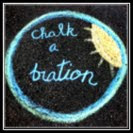
Chalk-A-Bration is coming up next Saturday. (This is a celebration of art + poetry started by Betsy H.) Next Saturday my kids and I will be chalking and writing poetry to share with the Chalk-A-Bration community. Won't you consider joining? Here is a link to July's Chalk-A-Bration to give you an idea of how to participate. Simply chalk your poem, post a photo and link up next Saturday, August 31, at Teaching Young Writers.


You won't want to miss the MAKING FISH FRIENDS Blog Tour hosted by Chronicle Books. Kate Messner's latest picture book, Sea Monster and the Bossy Fish, is a must-read. Follow the tour -- most stops are hosting a giveaway, so perhaps you'll be a lucky recipient of Sea Monster and the Bossy Fish!  Here is the link to the blog tour information with a list of links for each stop. Kate will be here on Monday with a guest post. In addition, Chronicle Books is offering a 30% discount in celebration of Kate's new book. Simply use the promotion code SEAMONSTER. The offer ends on September 6.


If you've been reading my words for awhile, you know I'm a believer in little things leading to BIG understandings. This week I was surprised to find a little thing I did was featured in a Slice of Life post. The thing about little things is, when they are happening, it is easy to miss that they are really a big thing. Here's a link to Cathy's blog post about this little note I left her. (I snagged the image off of Cath's blog since I would have never thought to take a photo of something so little.)


Finally, I'm doing some deep thinking about conferring. I'd love to know your conferring angst. What do you find most difficult about conferring? Please add your thought to the comments on my post here. Thank you!

Monday, August 5, 2013

the book stack: where it's been

If I'm gutsy-honest, the kind of honest that is see-through and stark and you wonder if people are still going to like you when you're done being honest, then I'd say this:

I'm not reading the way people think I read.
This makes me feel like I'm not a worthy reader.

{Deep breath.}

There it is. I'm not the same reader as I was a year ago. A year ago I was reading 3-5 young adult books every week. A year ago I read a middle grade novel each week. A year ago I was absorbed in books about fiction writing. A year ago my kids and I were reading mass amounts of picture books daily. 

I supposed it shouldn't be a surprise since so much of life has changed in the last six months with the adoption of our fourth child. Yet there's a letting go of the way things were and an accepting of the way things are. And this is true not only for the mom-me, but for the reader-me too.

I'm still reading, just not the same things I was reading. Yet, I'm operating in the same circles as before and I feel fake. I feel like I'm not keeping up my end of the reading-deal. 

And if I'm still being gutsy-honest, this makes me feel like: 
I'm not a good enough reader, which makes me not a good writer or a good teacher or a good blogger.

Now I know there will be people on the other side of the screen shaking their heads because they see the messed-up logic in this thought process. And I know it too, in my head. But when I'm joining a conversation with readers like the kind of reader I used to be, it is easy to feel in my heart that I'm not worthy any more. It's easy to believe I don't have much to bring to the table.

What I'm realizing is I do have something to bring to the table. Although my reading life is full of adoption resources, books about adjustment and bonding and parenting children who have a history with out me, and it is overflowing with books about faith and miracles and stories of overcoming the hard by grace, and my reading this year has taken me through 68% of the bible, and even though my children are transitioning into more independent reading, I still am reading some about writing and some fiction and some picture books.

So perhaps my answer to the question:

is a little slimmer than before, but I still have an answer involving something from picture books to YA. And although when I join the conversation of what others are reading, I may have to be more selective about what goes in my book stack because I'm a different reader than before, it doesn't mean I'm a worthless reader and it doesn't mean I'm a fake writer and it doesn't mean I'm a lousy teacher.

It simply means I've changed.
And that's okay.

And now for the real purpose of the meme: Something I'm reading -- 


Mr. Flux by Kyo Maclear + Matte Stephens (Kids Can Press, April 2013) was a book I needed to read this week. I love it when the timing of the book is undeniably perfect and you get a story perfectly in sync with your life. 

In the Author's Note at the end of the book, we find the story is loosely based on a man named George Maciunas who was a Fluxus artist. Fluxus is a fancy word for change. The book is about a man who brings change to a community who prides itself in staying the same. 

I resonated with Mr. Flux and he reminded me change is good and those who are agents of change must protect themselves from cynicism and stagnation. Add in the whimsical illustrations and muted colors and I'm inspired to return to school and foster big change through small and seemingly insignificant changes.

This is a book I look forward to sharing with other instructional coaches as well as with teachers as we think about nudging our craft of teaching to constantly evolve and grow.

Thursday, August 1, 2013

my colleagues: one take-away from a writing retreat

A writing retreat from Brenda Power is a gift. I still have a hard time believing I'm the kind of person who gets to write and finds herself at a writing retreat.

Although the focus was on our writing habits, I'm learning something more about colleagues at the Choice Literacy Writing Retreat hosted by Brenda Power. Often times, in my little bubble of the "real" world, I feel like I'm radical. My views seem to push all of the wrong buttons and I begin to question if maybe I am half-crocked and playing in left field.

Then I sit in a room with this little group of writers and I realize I'm not radical. In fact, I'm a little behind the times. I need to read this, think about that, enter another network in order to be cutting edge.

I'm realizing I don't need to be bound by walls in defining colleagues. My colleagues can be people from around the globe. We aren't colleagues because we work in the same locale, but because we work together, in the business of empowering children to be learners, thinkers, creators, and innovators who will make the world a better place.

So I'm expanding my notion of colleague. And I'm remembering the business I'm in. It is not the business of raising test scores. Rather, it is the business of empowering people (whether they are 3 or 83) to make the world a better place. I love that I have colleagues, some I've never met in person, but we are in the same business and they help make me a better educator.

Here are the colleagues who were pushing my thinking, encouraging me as an educator, and nudging me to be a better writer. I'm very grateful for each of them.


I'm not the only one they push, encourage and nudge. Check them out online:

Brenda Power (@choiceliteracy)
Max Brand
Bill Bass (@billbass)
Katie DiCesare (@katiedicesare)
Shari Frost
Deb Gaby (@debgaby)
Franki Sibberson (@frankisibberson)
Katherine Sokowlski (@katsok)
Jen Vincent (@mentortexts)

Tuesday, March 19, 2013

You're going to wish this was waiting for you...

This was waiting on my doorstep when I came home today...


It is a treasure -- an entire book of poems by Amy Ludwig Vanderwater. You know Amy, right? She hosts two remarkable blogs, The Poem Farm and Sharing Our Notebooks.

You're going to want Forest Has a Song for your poetry collection. Spend some time over at The Poem Farm and you'll understand why. I'm going to read Amy's words again, savoring as poetry is meant to be enjoyed. The first time I read it I devoured it as quickly as possible. Now I'm sinking into a comfy spot, dressed in comfy clothes, and allowing the words to seep into me and restore me. This is the power of poetry.

{Posted from my iPhone}

Thursday, March 7, 2013

when i grow up

First thing this morning  I was talking with seven 8th graders about reading. We were waiting to begin our state testing, because of late buses.  "Teachers just make us read books they want us to read. None of them are ever good," one student said.

She was quickly supported by other students. In the middle of the room sat a boy with a Christopher Paolini book. "Hunter's a reader," I said.

He nodded.

"I remember the year you became a reader. Third grade, right?"

He nodded again.

"How?!?" the girl next to him blurted. I smiled at her shock that someone could actually become a reader.

"Mrs. Bean." A single name was a complete answer for him.

"Everyone becomes a reader if they are in Mrs. Bean's class," I said.

"A teacher turned you into a reader?" The girl was still stunned.

"Yes," Hunter said.

"What'd she do?" asked another student.

Hunter shrugged. Just when I thought he wasn't going to answer he said, "She helped you find books you wanted to read and she didn't let you waste time with a bad book. Everyone had book stacks on their desks and she talked to us about our reading. I mean, she taught me there's good books out there and how to read so they made sense."

"If there's a book you want to read and you're in Mrs. Bean's class she gets it for you," I added.

"You could keep it too, if you asked." Hunter said.

"Huh. You mean she didn't make you read stupid stuff?" She was flabbergasted.

"Nah," Hunter said. He thumbed the pages of his thick book. "I mean she read books to us, but they were always good. Then after a book we'd do something fun, like dress up or something."

"You know, that was five years ago," I said. "Yet you still like reading now. How come?"

Hunter looked at me. "Once you know there's good books out there, you just want more."

You won't meet a better teacher than Mrs. Bean. She loves books, but she loves her students more. In fact, she loves them so much that she works until they love books too. Then she teaches them to read so the books they love make sense. And it's instruction that lasts. It's not just reading for school, but reading for life. Her students grow up and they want to read more. This is just one of the many reasons I want to be like Mrs. Bean when I grow up.

Click the image to join us at
Two Writing Teachers for the
Slice of Life Challenge.

Wednesday, September 5, 2012

ivy + bean take care of the babysitter: videos

This week I'd like to share a couple of videos with you. First is a must see book trailer for the series. It is perfect to show in classrooms to help get readers excited about Ivy + Bean.


The next two are longer, but I find them interesting because they are interviews with Annie Barrows and Sophie Blackall. Any time I can pick up interesting bits about writers or illustrators, I think it is a good use of time.


This week Chronicle Books is giving away Ivy + Bean Take Care of the Babysitter.

And three sets of mini notes.

Just leave a comment on this post before Sunday night. I'll post giveaway recipients  on Sunday before I go to bed. If you receive a giveaway, your name will be placed in the grand prize drawing.


Don't forget to check out these other blogs:

Monday, August 27, 2012

2 gems

These two books are complete and total gems for all writing workshop teachers. Trust me, you'll want to add them to your collection to help you teach narrative and informative writing as well as poetry. If you know me, you know I'm not usually insistent on using certain books for writing workshop. I believe you should find the books you love. However, if you're looking for some mentor texts, these are two I think will go the long haul.

(I feel like we need a drum roll...)


GILBERT GOLDFISH WANTS A PET by
Kelly DiPucchio and Bob Shea, Dial Books, a
division of Penguin Young Readers Group, 2011

Gilbert Goldfish Wants a Pet by Kelly DiPucchio and Bob Shea has been a favorite of mine for several months. It's a favorite of Sam's as well. I think we read it every single day in the month of July. All this re-reading made me realize what a goldmine it is to teach narrative structure at many different grade levels. In fact, I can see myself bringing this into a middle school classroom.

Almost everything I want to teach about narrative, I can teach using this text. For example, I could teach:
  • Tension
  • Internal conflict
  • External conflict
  • Structure
  • Unexpected endings
  • Action
  • Character motivation/want
  • Strong hook
  • Setting
  • Plot development
  • Emotion
I'm also a huge fan of Bob Shea's work. For primary grades, this text is a rich source of illustration lessons:
  • Text placement
  • Zoom in
  • Zoom out
  • Setting details
  • Character details
  • Color
  • White space
  • Emotion
  • Movement
  • Thinking
  • Noise


A STRANGE PLACE TO CALL HOME:
THE WORLD'S MOST DANGEROUS
HABITATS & THE ANIMALS THAT CALL
THEM HOME by Marilyn Singer
and Ed Young, Chronicle Books, 2012. Click
on the image for more information about the author.
A Strange Pace to Call Home by Marilyn Singer and Ed Young is a treasure from cover to cover. First, let's start with the title and subtitle. There is so much to learn about titling an informative project. Inside, you will find an introduction, "Risky Places," to orient you to the book. Then there is a collection of fourteen poems, focusing on animals that survive even in the worse places on the planet. The back of the book offers a guide to forms of poetry, identifies different poetic forms used in the collection, and gives more information about each of the animals.

What makes me so excited to use this book in writing workshop? I love how there are different forms of informative writing. There is an introduction that would be worthy of using during a feature article study, poetry, and more information written in prose about each animal. The information at the back of the book could be used in feature articles, essays, posters, brochures, or summaries studies. I love how research is used as the backbone for this text. I love the way you can go deeper into a study of poetry. I'm positive I could find hundreds of minilessons in this book for informative writing and poetry.

How about you? What are some new favorite mentor texts you're planning to use in writing workshop this year?

Join Jen & Kellee for the Monday meme
by clicking on the image.

Wednesday, August 22, 2012

ivy + bean: book 2 (minilesson possibilities)


One thing I was struck by in Ivy + Bean and the Ghost that had to Go was the way Annie Barrows crafted action throughout the book. The opening scene involved gymnastics. I've met many young writers who want to write about gymnastics. I can't wait to share the way Annie Barrows stretches the action of a backbend. Check this out:

Then she arched over backward. She flung her arms over her head and made a perfect backbend. She looked like a turned-over pink teacup. Then she rose back up --- boing --- like a doll with elastic in its legs.
---Annie Barrows, Ivy + Bean and the Ghost that had to Go 

I can imagine teaching from these lines over the course of a few days. Here are some minilesson teaching points I'm eager to share with young writers...

  • Writers often stretch action by adding a line of character description. Then they return to the action, and leave readers with a vivid picture of how the character looks when doing something.
  • Writers use onomatopoeia (sound words) to help the reader imagine the action even more.
  • Sometimes authors use a comparison to help the reader see the action more clearly. Annie Barrows uses two similes in this short passage.
  • Its. Here is a prime opportunity to teach why it doesn't need an apostrophe!
  • Writers use specific action verbs like arched, flung, and rose
  • Dashes -- Check out how Annie used them to set apart the word boing. It almost feels like the sentence boings in the center of it! Writers sometimes use dashes when they want to startle readers and make them pay attention.
I'm sure you notice other teaching possibilities too. It is unlikely that I would teach all of these, however, they are all valid options, depending on the needs of the class. 


Leave a comment on this post and you'll get a chance to receive...

One person will receive book two in
the Ivy + Bean series.
Three people will receive mini note cards.
And if you receive a giveaway,  you get a chance at the grand prize...

Make sure to check out more inspiration from Ivy + Bean and the Ghost that had to Go at these other blogs:


Monday, August 20, 2012

the book stack

I now have another author that I must read everything he's ever written.

BRUISER by Neal Shusterman, Harper Collins Publishers, 2010.

Christy Rush-Levine nudged me to read Bruiser, since it is her favorite book by one of her favorite authors, Neal Shusterman. So as part of our 100 Book Celebration, I left the bookstore with a copy of my own. 

I read it quickly, as is typical for me, but the story has grabbed hold and won't let go of me. I'll be reading it again, studying it, trying to figure out exactly how Shusterman crafted the story. It is, quite simply, remarkable.

Told from the voices of four characters, it made my heart twist at some points and swell at others. There are not many books that have made me feel so deeply such a diverse range of emotions. I loved the characters and I hated them.

Of course I had to search out Neal Shusterman online. His website is elaborate, and he now has a new Twitter follower. These words, from his bio page, spoke to me.


I consider myself very lucky to have a career doing what I love. Of course it's a constant challenge to come up with stories that are original, meaningful, and capture the attention of readers. When I sit down to write, I always ask myself. "What is this book adding to the world? Why is it WORTH writing." Writing a good story is only the first part of it. I want my stories to resonate. I want the reader to not just read the words, but to FEEL the ideas and questions echoing deep inside. I don't like giving answers, because the only questions worth asking don't have simple answers. I prefer to ask questions that will challenge you to think, and see the world - and your own life - in fresh ways. The way I see it, a book should be a powerful experience. It should make you see new colors you never imagined existed - but now that you've seen them, you can see them everywhere.

I think you should pick up Bruiser. The sooner, the better.

Find out what others are reading and share your stack with:

Click on the image to see more reads at Teach Mentor Texts with Jen and Kellee.

Wednesday, August 8, 2012

gasp!

I can't believe it's August and I forgot.
{deep breath}
WFMAD.
{an experience that made me believe I could maybe, perhaps, actually write fiction}

Write Fifteen Minutes a Day, a writing challenge hosted by Laurie Halse Anderson on her blog, Mad Woman in the Forest, is something I've participated in for several years. I love it.

In an effort to embrace what I can do and let go of the things I don't do, I'm going to be excited that I remembered and happy to have TWO fifteen minute writing experiences for the next week, as I double up and relish in the surprises that always come with WFMAD.

I hope you join. It's always more fun to do something together.

I'm off to spend some time with my notebook. Here's today's challenge.

Wednesday, July 18, 2012

guess what i just bought

Click on the image to find out more.
Tickets.
On a Thursday night.
Nearly 5 hours away.
Andy agreed to miss work, too, in order to go with me.
I just had to figure out who would get the kids from school, help them with homework, feed them dinner, put them to bed, wake them up, and get them to school the next day. Thanks, Mom.

All so I can hear Maggie Stiefvater talk about her work as a young adult author with book blogger Lynn Rutan.

I.
Am.
So.
Excited.

Jealous, anyone? Click on the image if you are near Traverse City, MI (or even if you're not, but are willing to drive) to get tickets and be as excited as I am. :)

Okay, off to do more happy dancing.

Sunday, July 15, 2012

laura resau interview (part 3 of 3): plot threads

One of the things I've been struggling to get a handle on as a writer is weaving a number of plot threads together in an interesting and clear way for the reader, while at the same time remembering and balancing them as a writer. Laura Resau's The Jade Notebook is an exceptional example of the weaving many plot threads together into a beautiful story. In this final part of the interview with Laura Resau, she shares some insights into plot.

I love the way you wove many different story threads to create a rich story with lots of depth in The Jade Notebook. What is your process like in order to tie so many threads together? How do you  balance planning specific scenes, while at the same time giving the story space to unfold as you draft?


Thank you! You know, I was on a tight deadline with the Notebooks series, which spanned from the time we adopted our baby (nine months old) to this year, when he was four. I was also writing and revising other books during that time, so I was really struggling to find time for everything. After I finished the second book in the series (The Ruby Notebook), my mom, who is my most trusted and competent critiquer (right up there with my editor), advised me to make the third and final book (The Jade Notebook) relatively short and simple, to make life easier for myself. I tried, but I just couldn't do it! I think it has to do with the fact that my characters come alive for me, even the minor ones. I feel compelled to tell their stories as well, and find a way to let their subplots connect with the main character’s one.

Early on in the manuscript, my process involves going back and forth between first-drafting (which is mostly free-writing for me) and outlining (my outlines are always changing to accommodate the discoveries I make as I free-write more of the story.) At some point, I end up with a rough first draft that is full of holes in places and bogged down with unnecessary scenes and words in other places.

My mom then comes in to save the day! She’s the kind of person who loves untangling necklaces and hair. Apparently, it’s meditative for her. Lucky for me, she has an uncanny ability to analytically untangle my subplots and figure out how they need to be woven together. She can masterfully detect missing scenes and tell me what scenes I need to add and where. So, my advice is: if you’re not analytically-minded about plot, then find someone to help you—preferably someone who loves you unconditionally like a mom, someone who will drop everything she’s doing to read your messy draft and somehow get back to you with advice the next day.

If you need to bumble through it alone, here’s my two cents: I think that integrating subplots involves an analytical part of your brain that’s different from the creative-free-writing part. I think you need to periodically step back from your organic free-writing to make lists, charts, outlines, graphs—whatever helps you tap into that analytical part of your brain. You could go through and highlight different sub-plots in different colors, or even cut and paste together pieces of each strand of sub-plot (kind of “unbraiding” them in a separate document) to get a sense of the sub-plot continuity or lack thereof. (Does that make sense?) Some authors I know fill out note cards with scenes from their story, sometimes color-coding each of the subplots, and then physically rearrange them on a bulletin board (or the floor or a big table) to figure out how the strands and layers fit together. It can be headache-inducing work… good luck!

Most of all, I encourage you to find trusted readers—critique partners or group—who will really take the time to go through and get their hands messy and analyze what’s going on in your story, plot-wise. Happy writing, everyone!

Somehow, this was just what I needed to hear. I think it gave me resolve to keep going, knowing in the end there are going to be "holes in places and bogged down with unnecessary scenes and words in other places." These words from Laura, coupled with this #TeachersWrite post about outlining helped me start trusting myself and writing my story again. 


Thank you Laura for taking the time to give insightful and inspiring answers. Good luck as you continue to write. I'll be looking forward to reading your next books! Remember to continue getting more inspiration from Laura you can read her blog, check her website, or fan her Facebook page.

Friday, July 13, 2012

laura resau interview (part 2 of 3): writing space

I believe in the power of place and the importance of space. After I was in my new office for a couple of years I had to do something to make it mine. I worked at establishing a place that reflected who I am and was comfortable and inviting to work. (Here is a link to a blog post about organizing my office at school. The interesting thing is now, two years later, almost all of my files are electronic, and I no longer have a school computer because I work off my personal laptop.)

Having a space to write is important too. I often think about ways to make classrooms inviting to student writers. How can it become comfortable and inspiring? What are ways to organize the space for writers? How can space become another teacher for students in writing workshop?

If you hop over to Laura Resau's blog, you can't help but notice an invitation to tour her writing space -- a shiny silver trailer. On the right side bar there is a picture of the writing trailer and a link to go for a tour.

Naturally I was curious and wondered a little more about how this space influences Laura's writing life. So I asked: Your writing trailer seems to be an important part of your writing life. Will you talk about this space and how it impacts your work as a writer?


Check out the tour and then read Laura's response.


My writing trailer makes me so happy! I bought it on an impulse about five years ago, when we were waiting to finalize the adoption of our baby from Guatemala. My husband and I lived in a small house with two bedrooms, one of which was my writing room. When I the realization sunk in that I’d have to give up my writing space for the baby, I freaked out. I knew that somehow I’d need a room of my own. I went on Craig’s list and stumbled across a “sweet lil fifties rig” – a silver “canned ham” style trailer-- for an affordable price. It’s completely uncharacteristic of me to jump into big purchases, but I bought it on the spot… and it’s been one of the best decisions of my life (up there with adopting our beautiful son!).


My trailer was a life saver for me as a new, overwhelmed mom with book contracts and deadlines looming. For a few hours each day, I’d retreat into my special creative space (permanently located in our driveway) while a babysitter or my husband watched our son. Stepping into the space, I could leave behind all the mundane worries and hassles of life and motherhood, and immerse myself in my story-in progress. I took joy in filling my trailer with inspiring and meaningful things that connect me to my creative source. Some of these include tiny bells, a comfy futon with heaps of pillows, old pictures and favorite books, vintage goodies from second hand shops, finds from markets around the world, little treasures from friends, beeswax candles…


This past year, we decided to do an addition to our house (which became necessary once my husband started working from home, too). During the construction, we had to be in rental homes for nine months, and sadly, I had to put my beloved trailer in storage. It was heart-breaking for me—I missed my creative space like an old friend. When we recently completed our renovation and went to pick up the trailer, I nearly cried in relief. When I stepped inside after the long absence, and smelled its deliciously musty, magical smell, I felt a rush of love and gratitude. Although now, after the addition, I do have a writing studio in my house, I’ve found that my trailer is still the best place for me to leave distractions behind and delve into creative writing. The space feels sacred to me. Now I can do emailing, business-y internet stuff, and book promotion activities inside my house, but my sweet lil fifties rig remains the place where I feel most purely and powerfully tapped into my creative source.


If any of you are feeling like you need your own magical space to create, I highly encourage you to think outside the box to find a solution!

How about you? What kind of writing space do you have? What can you do to make it magical like Laura's? 


This is part two of a three part interview with Laura Resau.
Part 3: Plot Threads (Check back soon!)

Check out more about Laura Resau and her books here