Don't miss my website!

Don't miss my website! Video lessons and more for teaching writers.
Showing posts with label coaching. Show all posts

Thursday, January 26, 2017

9 Reasons I Keep Conference Notes

I'm putting the finishing touches on my new online self-paced workshop about establishing and using a record keeping system for writing conferences with students. (I really need a good name for it. Let me know if you have an idea. I'm terrible at naming things.)


I decided to collect some fresh conferences to use in the course, so I emailed a handful of teachers. Whenever I decide to invite myself into a classroom, I have two prerequisites --

  1. The teacher won't panic and flip out and spend extra time getting ready for me.
  2. The teacher will be honest with me about their writing workshop habits and thoughts.
Today, two of the three teachers pushed me about the point of keeping conference notes. Both said a version of this:

I know where my students are as writers, so why should I write it down?

My inbox is filled with questions in the same vein. 

How can I make a system that makes sense?
I have a hard time getting to my notes.
I forget to write down notes.
How do I take notes that are relevant?
How do I convince teachers notes really matter?
How do I know what's important to note?

(I have the best Email Pals who hit reply to this week's note and let me know their questions about keeping conference notes. If you have a question, leave it in the comments.)

I might have had a moment today when I thought, Is it important to keep conference notes?

After spending lots of time thinking (I drove more than 5 hours today), I feel the same way about conference notes tonight as I did when I woke up this morning.

Conference
notes
are
essential.

  1. They help me make sure I meet with every kid. Not just the ones who need me, but all of them. Regularly.
  2. They keep me intentional and purposeful. They hold me to affirming and teaching in all conferences.
  3. They prevent me from going in blind to a conference. After a couple of weeks, I've noted needs for every kid. Before a conference, I just look at the previous notes and I have an idea of what I'll teach.
  4. Let's face it, no matter how great we think our memories are, they fail. I go into the grocery store for three items, grab two things and can't  remember the third item I needed. I don't remember where I put my car keys. I forget to turn in my mileage. We are human. We are teachers. Our brains are filled to the brim. There is no reason to use storage space on something I can write down.
Those are just the reasons that make me a stronger writing teacher. My real motivation for keeping conference notes is because they allow students to become stronger writers.
  1. They allow me to select the most pressing need for every kid. It's not always the first thing I think of and it isn't always the way the conference is leading. Conference notes force me to think through students needs and goals as writers and then make a decision to teach the writer during every conference.
  2. They offer evidence of growth. Through my conference notes, I know where students are in relationship to writing standards, as well as at different milestones in the year.
  3. They allow me to have a single writing conversation with students across time. Conferences are connected. Previous teaching points guide me in reteaching or affirming new learning. Accomplishing goals allows me to see the new needs. Conferring moves from a whim to an intentional teaching move.
  4. They provide patterns in the class. I can determine upcoming minilesson objectives or organize small groups for differentiated instruction. 
  5. They become rich data sources for others in the school -- special education or high ability teachers; principals and RtI teams; as well as future teachers. We can work together instead of working harder to meet students' needs.
Leave a comment and let me know:
  1. Why do you think conference notes are important?
  2. What questions do you have about conference notes?
  3. A stellar title for me new course!

Tuesday, September 30, 2014

Teaching Paragraphing

Last night Annabel Hurlburt and I were talking about helping fourth grade writers organize their narratives with paragraphs. Annabel has done an incredible job of helping her students think in scenes and craft a story. As we were looking at some drafts, we realized starting new paragraphs wasn't automatic for most writers in the room.

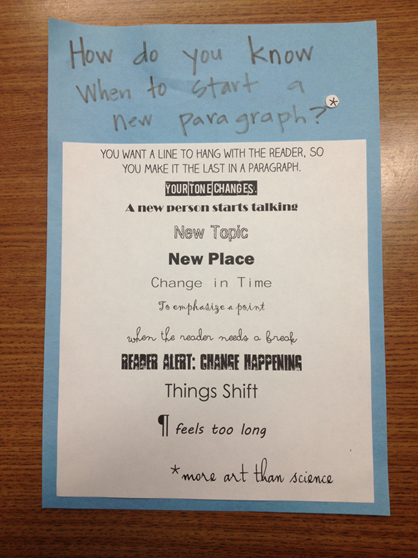
I was reminded of the tricky nature of knowing when to start a new paragraph. Several years ago, I posed the question to Two Writing Teacher readers: How do you know when to start a new paragraph?

The responses led me to accepting this truth: Knowing when to start a new paragraph is more art than science.

Below is a repost of the original, along with an image of the chart. For most elementary classrooms, we wouldn't teach all of these at the same time, but rather select a few that go along with the learning that is already happening. Then we could offer the invitation to students to notice other times authors start new paragraphs and add to the chart as we go through the school year.

One more thing, if you have a few extra minutes (and even if you don't), I highly recommend this post from Annabel about what she believes when it comes to teaching writers. I find it both inspiring.

*****

I took your wise words and put them together in a chart. It’s hanging in my office because I love how it is a reminder of the power of collaboration. It also restores my faith in our ability to teach conventions through writing workshop. I love (and I mean lovelovelove) that no one offered a sentence number as a means of knowing when to start a new paragraph. I’m sure we’ve all met our share of students who count sentences and then start a new paragraph. 

Ugh.

As many of you know, I’m a big believer in the power of art. I’m working to create charts with a strong visual presence with the intent of helping students retain their learning through the visual stores in their brains. Creating this chart reaffirmed to me the importance of first collecting ideas and then organizing them on a chart.

So my thoughts on paragraphing…

As Liza Lee Miller said in the comments, “It is an art.” I’ve been paying close attention to my own work with paragraphs and I’ve realized it is truly more art than science. Tara’s comparison resonated with me — knowing where a paragraph starts is like knowing when to shift the gears of a manual transmission. There is an element of “feeling” the paragraph shift while writing. Of course there are the nonnegotiables: new speaker, new time, new setting, new idea. These just aren’t enough, though. There are many other times when a new paragraph begins. Outside of school assignments, I’ve never made a paragraph shift based on the number of sentences.

In addition, I find it unrealistic to set paragraph limits for different genres. For instance, who’s to say how many paragraphs will make up a short story? It depends on dialogue, setting changes, and lines that need emphasized. Instead of thinking in paragraphs, I’ve shifted my thinking to considering parts. It is realistic to say  a short story for a seventh grade writer will have 4-6 scenes. Paragraphs? I’m not even going to try to touch that.

Sometimes I think teachers set sentence limits and paragraph requirements with the good intentions of helping students elaborate. Rather than demanding more details, I make an effort to help students learn ways to elaborate. In Shelley Kunkle’s short story unit, we’ve taught students to build scenes not with 5 sentence paragraphs, but with snapshots and thought shots (a la Barry Lane), character action, dialogue, object description, character description, flash backs, and incorporating another genre such as a letter or poem. (There’s another post all about how everything from object description on in this list came from students during share sessions.)  They are elaborating with intent and their writing is strong.

Today we talked about paragraphing. Because Shelley and I have extended their repertoire of elaboration tools, students were able to feel the “shift” when it was time to start new paragraphs. I shared my notebook with students, my messy collections of words, and asked students to notice the way I use paragraphs, even in my private notebook writing. It’s a habit I’ve established and a habit I hope for students. Today they were intentional about using paragraphs as they drafted.
In another post, I hope to reflect on the way paragraphing decisions influences my revision work much more than my editing process. But that will have to wait for another day. Until then, thank you for joining this conversation and pushing my thinking when it comes to conventions in writing workshop.

Saturday, March 29, 2014

CELEBRATE This Week: XXIV


I'm glad you are here to celebrate! Share a link to your blog post below and/or use #celebratelu to share celebrations on Twitter.


My favorite celebrations are the glimmers in the midst of everyday life. The small joys and triumphs that make a big difference. I love to celebrate small as a means to live big. Today, however, I'm sharing a celebration that is a little outside of my ordinary. Today I share a step toward a dream.

Last November at NCTE, Colby Sharp and I ended up sitting together in a session. We started talking and Colby asked, "So you're a coach, right."

I'm not sure how I answered, but I confirmed that, "Yes, I'm an instructional writing coach." I left out the part about being a little disheartened and totally tattered by the whole coaching gig.

Colby said, "I miss my literacy coach." Colby moved from a school with a literacy coach to a school without coaches. I asked a few questions and listened closely. As Colby talked, I remembered the potential of coaches to change lives.

Little did I know it was a conversation that would change me. A few days later, with fingers shaking, I sent Colby a message via Twitter and asked if he'd want to try out my latest crazy idea. I wondered if I could be Colby's virtual writing coach.

His excitement and warm response gave me confidence and we began working together in December. We meet about three times a month via Skype. We keep a reflective journal in Google Drive. I send him attachments for drafting and planning and revising through email. He sends me photos and videos of his writers in action.

Colby has completely restored my faith in instructional coaching. He helped me take ownership in my role as an instructional coach and has made me more effective. He helped me realize that when I'm most effective as a coach, I'm living up to my calling as a Soul-Nourisher.

Franki Sibberson has also played alongside me in this virtual coaching role. With Franki, I helped facilitate a space for reflective practice on Google Drive. Katie DiCesare let me see inside her writing process and her work as a teacher-writer. Katie and Franki helped me remember how much I appreciate the privilege of walking alongside teachers as they work to become the best they can be. I am always humbled when teachers let me tag along for the adventure.

All of this led to a new dream. I really love offering professional development through speaking at conferences and schools, but the real fruits of the work come in an ongoing teacher-coach relationship with the focus on the actual students in the classroom. If we want to change the world by creating bold and confident writers, then our professional development needs to be as close to the classroom as possible.

There are many teachers who would love to have an instructional writing coach, but it isn't a reality in their corner of the world. I'd like to help make it a possibility.

So this week, I celebrate the launch of a new professional development option: instructional {e}coaching. Bring the professional development to you! You don't have to write sub plans and the conversation and work is anchored to your students in your corner of the world.

Find out more at my new instructional {e}coaching site: Discover Play Build

Now it's your turn. Link-up your celebrations below!

Saturday, December 21, 2013

CELEBRATE This Week X

Discover. Play. Build.

I'm glad you are here to celebrate! For more information, check out the CELEBRATE This Week page. Please use #clebratelu to share.

What happens when you don't want to celebrate? When you think you are too exhausted to celebrate?

You CELEBRATE anyway!

I'm keeping my brain focused on the things I can rave about this week.

One.
I had three conversations via Google Hangouts with educators across the country. They gave me energy and reminded me how very much I like working in a coach capacity. Thank you Katie, Colby, and Aileen!

Two.
We celebrated our first "official" Christmas with Andy's parents and sister's family tonight. It is very good to be a forever family.

Three.
I'm celebrating the life of my grandmother. She celebrated her 87 birthday last Monday. She passed away on Thursday. It is a bittersweet time of remembering, celebrating, and missing her. We will be in the midst of a 14 hour car trip as many of you read this post.

Four.
Christmas. Even though there has been a major change of plans (and my family will spend 50+ hours over the next 8 days in our car traveling), I continue to celebrate the season I love. I'm reminded it is not about my plans going smoothly that makes for a lovely holiday, but rather it is about being led by faith with its roots in a stable.

Looking forward to your celebrations. Please take a few moments to jot some down in the midst of your crazy-busy-life. I promise, you won't be sorry.

Thursday, September 19, 2013

Little Matters


It's the little things that matter. I'm realizing this is true when it comes to being an instructional coach. It is through small acts that great strides are made.

In the past week, I think these have been some of my most significant acts as an instructional coach:

  1. Bringing a cup of coffee to a teacher who was having a rough morning.
  2. Reading a book in a classroom I've never been invited into before today. (It's been a decade since I've started this position.) 
  3. Listening to someone tell a story about a daughter and a dog.
  4. Leaving a note and a book in a mailbox.
  5. Sharing a link to a blog post.
  6. Giving a hug.
  7. Gathering a basket of books to launch a unit of study.
  8. Sharing a Pinterest image.
  9. Giving a writing notebook.
  10. Drafting a survey for a principal.
For me it is easy to think these things aren't important. But they are. Little matters are not a little matter. I'm striving for small in order to make a big impact.